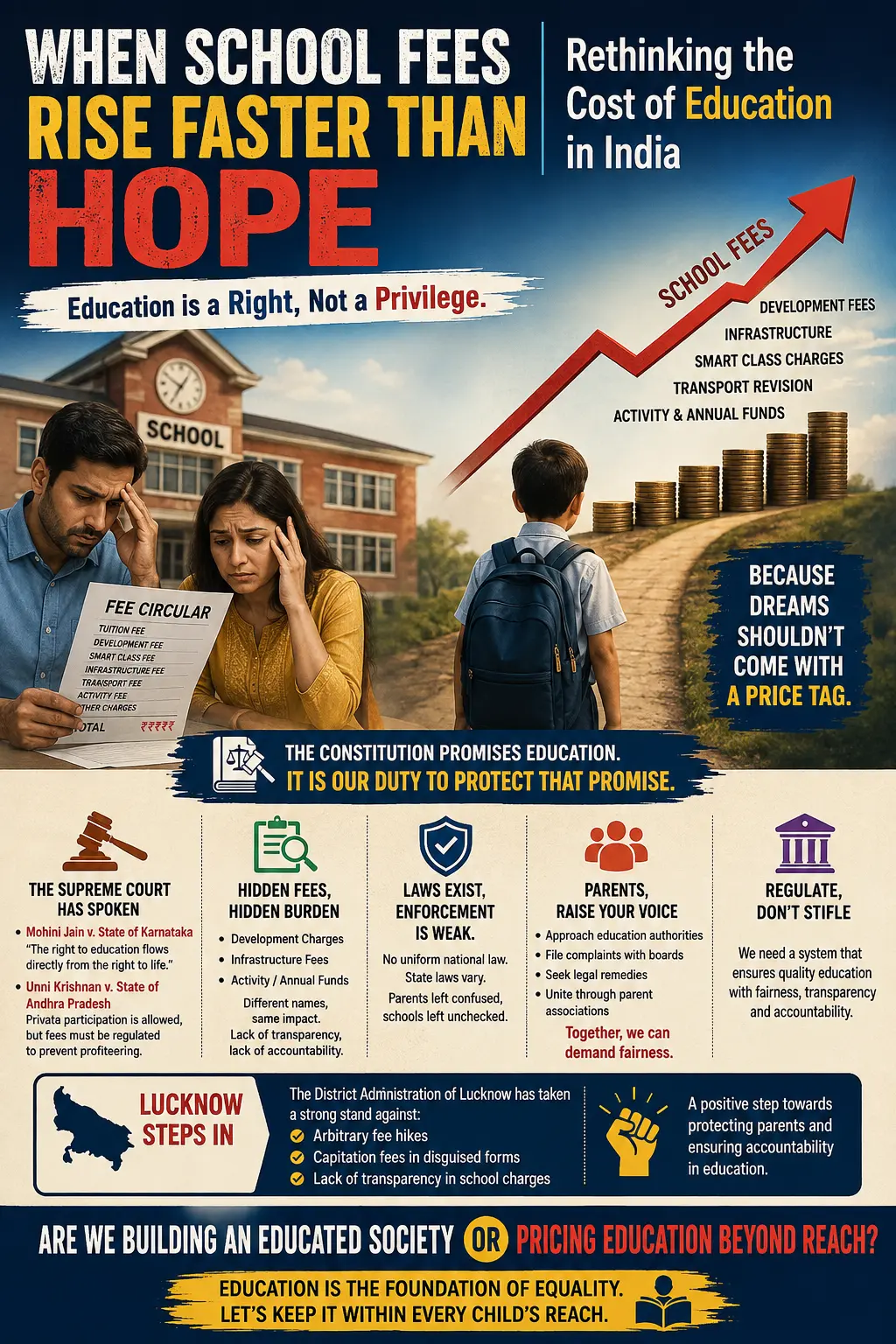
When School Fees Rise Faster Than Hope: Rethinking the Cost of Education in India
When School Fees Rise Faster Than Hope: Rethinking the Cost of Education in India
Dr. Arrpita Kapoor
As the new academic session begins each year, lakhs of parents across India brace themselves—not for report cards, but for fee circulars. What should be a moment of fresh beginnings increasingly feels like a financial shock. Uniform charges, “development fees,” smart-class levies, transport revisions—the list grows longer each year, often without explanation.
The unease this creates is not merely economic. It strikes at the heart of a fundamental question: Is education in India still a right, or has it quietly become a privilege?
A Right on Paper, A Burden in Practice
The Constitution of India envisions education as essential to a life of dignity. Through judicial interpretation, the Right to Education has been read into Article 21 (Right to Life). Later, Article 21A made free and compulsory education a legal guarantee for children between 6 and 14 years.
Yet, for many families, especially in urban India, “free and compulsory” feels distant. Private schooling—often seen as necessary for quality education—comes at a rising cost, with little clarity on how fees are determined.
The Supreme Court’s Observation
The issue of rising fees is not new. It reached the highest court decades ago, in a case that remains deeply relevant today:
Mohini Jain v. State of Karnataka.In this case, a student challenged the exorbitant capitation fee demanded by a private medical college. The Supreme Court delivered a powerful message:
“The right to education flows directly from the right to life.”
The Court went further, declaring that charging capitation fees was unconstitutional and violated the principle of equality under Article 14. It rejected outright the idea of education being treated as a commodity.
But just a year later, in
Unni Krishnan v. State of Andhra Pradesh,
the Court adopted a more nuanced approach. It acknowledged the role of private institutions but emphasized the need for regulation of fees to prevent profiteering.
The underlying principle was clear: Private participation is allowed—but not at the cost of fairness.
Capitation Fees: The Disguised Reality
Despite judicial clarity, capitation fees have not disappeared—they have simply evolved.
Today, they often appear under different names:
- Development charges
- Infrastructure fees
- Activity or annual funds
In essence, these are payments collected beyond the officially declared tuition, often without transparency.Education boards such as CBSE explicitly prohibit such practices. Schools are expected to operate as institutions of service, not profit. Yet, enforcement remains uneven.
A Patchwork of Laws, A Vacuum of Accountability
India does not have a uniform national law regulating school fees. Instead, states have their own frameworks—some stronger than others.
Recent developments highlight this inconsistency:
- In Delhi, attempts have been made to introduce stricter fee regulation laws focusing on transparency and accountability.
- Courts in multiple states have repeatedly intervened, questioning arbitrary hikes and lack of justification.
The pattern is unmistakable:
Judicial concern is consistent—but policy implementation is fragmented.
Lucknow Steps In: A Local but Significant Move
Amid this broader uncertainty, a recent intervention by the District Magistrate of Lucknow has drawn attention.
The administration has taken a firm stand against:
- Arbitrary fee hikes
- Collection of capitation fees in disguised forms
- Lack of transparency in school charges
Schools have been cautioned, and monitoring mechanisms are being strengthened.
This move is important—not just for its immediate impact, but for what it represents:
A shift toward administrative accountability in the absence of strong legislation.
However, it also raises a larger concern—should parents have to rely on district-level action for protection against systemic issues?
Why Fees Keep Rising
To understand the problem, one must look beyond the numbers:
1.Increasing Privatization
With limited capacity in government schools, private institutions have become the default option.
2. Commercial Pressures
Modern infrastructure, branding, and competition have turned education into a market-driven sector.
3. Weak Regulation
Even where laws exist, enforcement mechanisms are often inadequate.
4. Information Asymmetry
Parents rarely have access to detailed financial breakdowns, making it difficult to question hikes.
What Can Parents Do?
While systemic reform is needed, there are immediate steps available:
- Approach district education authorities
- File complaints with school boards (CBSE, ICSE, State Boards)
- Seek relief through High Courts or Public Interest Litigation
- Raise collective voices through parent associations
Courts have consistently intervened where fee hikes are found to be arbitrary or exploitative.
The Way Forward: Regulate, Don’t Stifle
The solution is not to restrict private education, but to regulate it effectively.
India needs:
- A uniform framework for fee regulation
- Mandatory financial transparency by schools
- Active parent representation in decision-making bodies
- Strict penalties for violation of norms
Regulation should ensure fairness—not discourage quality.
A Question That Cannot Be Ignored
At its core, this debate is not about numbers—it is about values.
If access to good education depends increasingly on the ability to pay, then the promise of equality begins to weaken.
The Constitution envisioned education as a means to uplift. The courts reaffirmed it. Administrations occasionally attempt to enforce it.
But unless policy, enforcement, and intent align, the burden will continue to fall on those least equipped to bear it—the parents.
And so, the question remains:
Are we building an educated society—or pricing education beyond reach?