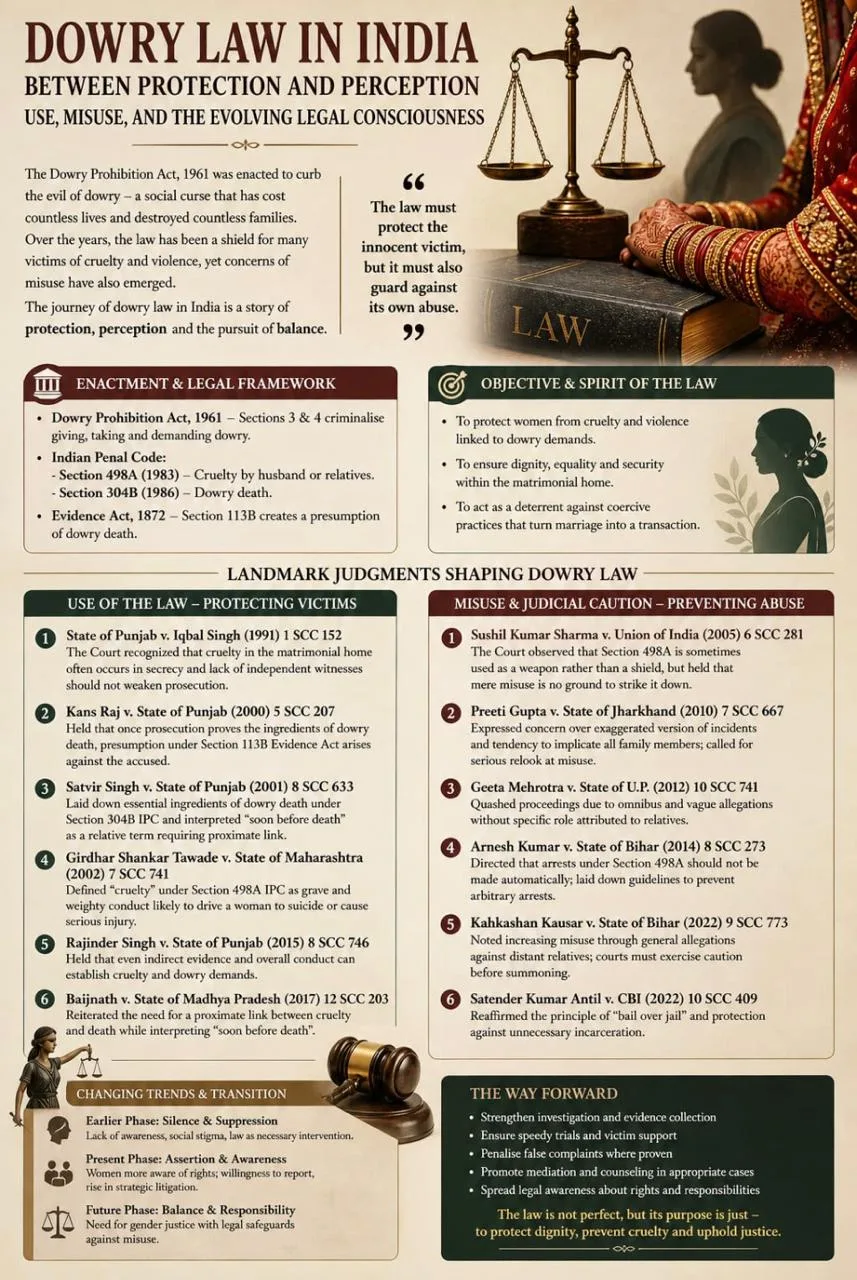
The dowry protection law in India was enacted to control the dowry harassment and deaths in India.
The dowry protection law in India was enacted to control the dowry harassment and deaths in India- a shield to protect the married women. Over the years, the human mind too evolved and thought of its misuse- a sword to attack the family members of the groom to harass them in turn to threaten them. When I am asked to comment on it, I have mixed feelings, for I have seen its transition between being used for the actual purpose and being misused. From the days when my father used to sit on the dias, I have seen and read case files which would send shudders through one’s body (based on evidences, when manipulation, distortion and tampering were a rare phenomenon). The intensity of the cases was such that it disturbed the judge and the entire courtroom. I remember vividly the days when cases of dowry deaths were scheduled for hearing, the atmosphere at our home was gloomy when my father returned from his court. That was the era when the law was serving its true purpose.
Coming to the present scenario, when I visit courtrooms or people come to us for consultation or when workshops are organized, irrespective of the economic background and the educational qualifications, people know one common line- we can get them behind bars under the dowry law’. Thereby stating clearly that the law served its purpose but as a society we have failed to acknowledge its true spirit. Many such instances have also caught our attention over the years as well.
Recently, the Supreme Court of India observed that even today dowry deaths are common in certain states of India and yes, it still holds true. The use and misuse have changed our perceptions of the dowry law, but the victims are both men and women-depending upon its use. What is more painful to see is the fact that rather than deterring the people who misuse it, the real victims of dowry, the families who have lost their daughters because of this evil social practice are the ones who are actually deterred from evoking it.
The trajectory of dowry law in India has been significantly shaped by judicial interpretation. Courts have not only enforced the law but have also refined its application to prevent both injustice and abuse. Below are some case laws that will help us understand the transitions through which the dowry law in India has undergone and how through judicial interpretations its striving to be gender neutral to serve its actual purpose.
Establishing the Framework of Dowry Death
Satvir Singh v. State of Punjab (2001)
The Supreme Court clarified the essential ingredients of dowry death, emphasizing that:
• The death must occur under unnatural circumstances
• It must be within 7 years of marriage
• There must be evidence of cruelty or harassment “soon before death” in connection with dowry
The Court importantly interpreted “soon before” as a relative term, requiring a proximate and live link between cruelty and death.
Presumption and Burden of Proof
Kans Raj v. State of Punjab (2000)
This case dealt with the presumption under Section 113B of the Evidence Act. The Court held:
• Once prosecution establishes basic ingredients of dowry death, presumption operates against the accused
• However, courts must guard against implicating all family members without specific roles
This judgment is crucial in balancing victim protection with protection against false implication.
Expanding the Meaning of Cruelty (Section 498A IPC)
Girdhar Shankar Tawade v. State of Maharashtra (2002)
The Court clarified that:
• “Cruelty” must be grave and weighty, not trivial
• It should be of such nature as to drive a woman to suicide or cause serious injury
This ruling prevents the dilution of the law into a remedy for ordinary matrimonial discord.
Recognising the Reality of Domestic Abuse
State of Punjab v. Iqbal Singh (1991)
The Court acknowledged that:
• Crimes within the household are often committed in secrecy
• Lack of independent witnesses should not weaken prosecution
This judgment reinforces why dowry laws must remain victim-centric.
Misuse and Judicial Caution
Sushil Kumar Sharma v. Union of India (2005)
The Court observed:
“Section 498A is sometimes used as a weapon rather than a shield.”
However, it also firmly held that:
• Mere misuse cannot be a ground to strike down the provision
This case captures the core tension in dowry law discourse.
False Implication and Over-Inclusion of Relatives
Geeta Mehrotra v. State of U.P. (2012)
The Court quashed proceedings against relatives due to:
• General and omnibus allegations
• Absence of specific acts of cruelty
Preeti Gupta v. State of Jharkhand (2010)
The Court expressed concern over:
• Exaggerated versions of incidents
• Tendency to implicate entire families
It called for a serious relook at misuse while maintaining the law’s necessity.
Safeguards Against Arbitrary Arrest
Arnesh Kumar v. State of Bihar (2014)
The Court laid down strict guidelines:
• No automatic arrests under Section 498A
• Police must justify necessity of arrest
• Magistrates must scrutinize arrest decisions
This judgment marked a turning point toward procedural fairness.
Strengthening Prosecution in Genuine Cases
Rajinder Singh v. State of Punjab (2015)
The Court reiterated:
• Even indirect evidence can establish cruelty
• Courts must consider pattern of harassment, not isolated incidents
Clarifying “Soon Before Death” Again
Baijnath v. State of Madhya Pradesh (2017)
The Court refined interpretation:
• Prosecution must establish a proximate link
• Mere past harassment is insufficient without connection to death
Recent Judicial Trend: Balanced Approach
Kahkashan Kausar v. State of Bihar (2022)
The Court observed:
• Increasing misuse through general allegations against relatives
• Courts must exercise caution at the stage of summoning
Satender Kumar Antil v. CBI (2022)
Though broader in scope, it reinforced:
• Bail over jail principle
• Protection against unnecessary incarceration
Integrating Case Law into the Larger Narrative
These judgments collectively illustrate the evolution of judicial thinking:
Phase 1: Protection-Oriented (1980s–1990s)
• Strong presumptions in favour of women
• Recognition of hidden domestic violence
• Expansion of “cruelty” and “dowry death”
Phase 2: Realisation of Misuse (2000s)
• Acknowledgment of false/exaggerated complaints
• Judicial warnings against over-implication
Phase 3: Balancing Mechanisms (2010s–Present)
• Procedural safeguards (Arnesh Kumar)
• Scrutiny of allegations
• Continued protection for genuine victims
The judiciary, through these rulings, has consistently attempted to maintain equilibrium between preventing dowry-related violence, while guarding against legal overreach
The law, therefore, is not static—it is continuously interpreted, corrected, and contextualized with the society influencing its usage to a great extent. It therefore becomes the onus of the society to ensure the appropriate usage of the laws, as a shield and not as a sword.