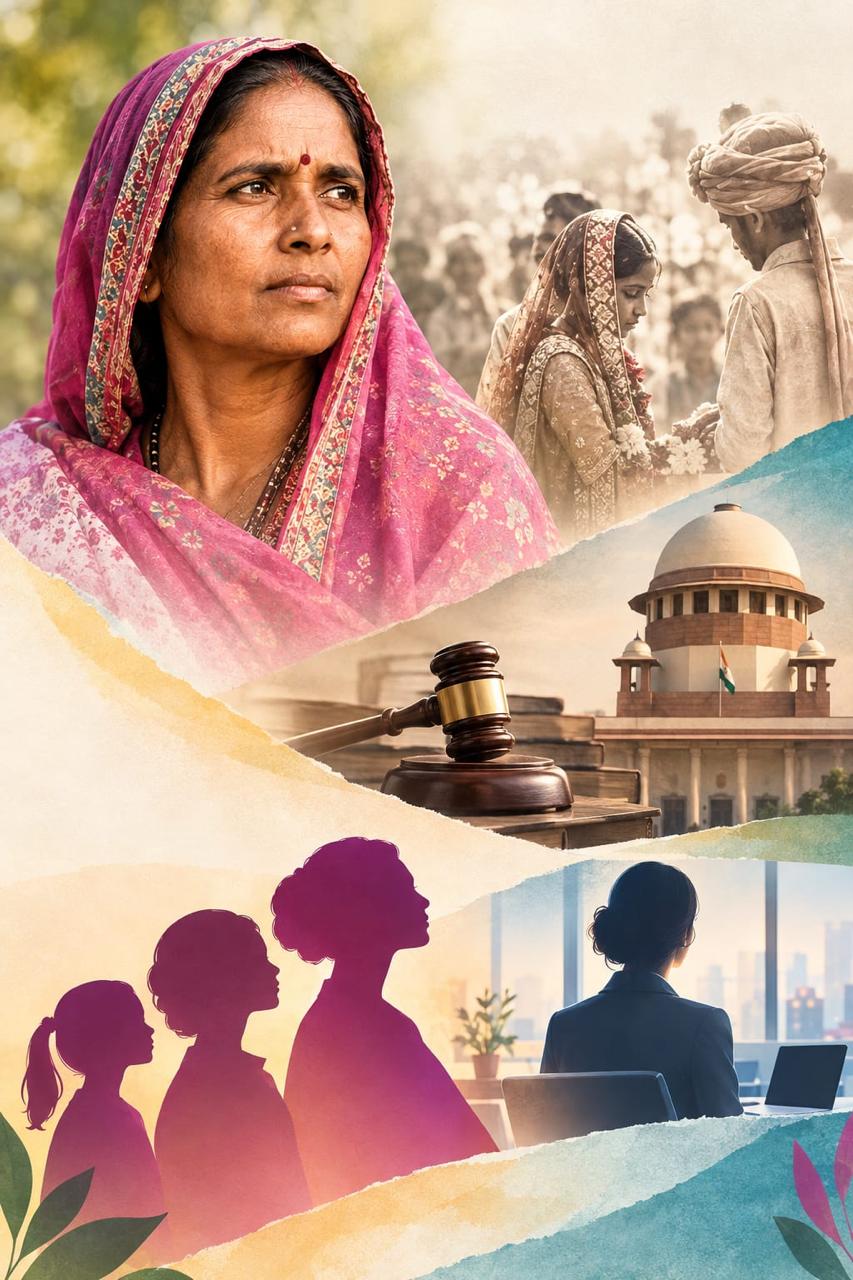
Discover the inspiring story of Bhanwari Devi and how her fight against child marriage led to the landmark Vishaka Guidelines and India's POSH Act, 2013. Explore the history of workplace sexual harassment laws and the importance of creating safe, respectful and inclusive workplaces for women.
From a Fight Against Child Marriage to the Birth of the POSH Framework: The Story Every Workplace Must Remember
27 November | International Day for the Elimination of Child, Early and Forced Marriage
Some laws are born in legislative chambers. Others are born out of injustice, resistance and the courage of an ordinary individual who refuses to remain silent.
The story of India's workplace sexual harassment law, the POSH Act, 2013, has a connection with one such extraordinary struggle.
And that story begins with Bhanwari Devi.
The incident that changed the course of workplace safety in India
In 1992, Bhanwari Devi, a grassroots worker (Saathin) associated with the Rajasthan government's Women's Development Programme, attempted to prevent a child marriage in her village.
Her intervention was an act of social responsibility. She was performing the very work she had been entrusted with: challenging harmful social practices and protecting women and children.
But her resistance came at a devastating cost.
She was brutally gang-raped by men from the community.
The incident was not merely an act of sexual violence against an individual woman. It was also an attack on a woman who had dared to challenge deeply entrenched patriarchal practices while performing her professional responsibilities.
Her struggle for justice exposed a much larger institutional failure: India had no specific legislation to prevent and redress sexual harassment at the workplace.
From Bhanwari Devi's struggle to the Vishaka Guidelines
The failure of the criminal justice process to provide Bhanwari Devi with justice galvanised women's rights organisations.
A group of organisations, including Vishaka, approached the Supreme Court of India through a Public Interest Litigation.
The case came to be known as Vishaka & Others v. State of Rajasthan (1997).
On 13 August 1997, the Supreme Court delivered a landmark judgment and laid down what we now know as the Vishaka Guidelines.
The Court recognised that sexual harassment at the workplace violated women's fundamental rights, including:
- Article 14 – Right to Equality.
- Article 15 – Prohibition of Discrimination.
- Article 19(1)(g) – Right to practise any profession or carry on any occupation.
- Article 21 – Right to Life and Personal Liberty, including the right to live with dignity.
The Court also recognised something fundamental: A woman's right to work cannot be meaningful unless she has the right to work in a safe environment.
The Vishaka Guidelines provided the legal framework for preventing and addressing sexual harassment at workplaces until Parliament enacted a dedicated law.
The journey culminates in the POSH Act, 2013
After years of advocacy and the landmark Vishaka judgment, Parliament enacted the Sexual Harassment of Women at Workplace (Prevention, Prohibition and Redressal) Act, 2013.
The POSH Act institutionalised the framework for prevention, prohibition and redressal of sexual harassment at workplaces.
It introduced statutory obligations, including the constitution of Internal Committees, prescribed complaint redressal mechanisms and placed responsibilities on employers to create safe working environments.
Today, when we discuss POSH compliance, Internal Committees, awareness programmes, employer responsibilities and workplace dignity, we are discussing a legal framework whose roots are deeply connected to Bhanwari Devi's struggle.
Why this connection matters on 27 November
The International Day for the Elimination of Child, Early and Forced Marriage reminds us that child marriage is not simply a social custom or a family decision.
It is a violation of human rights. It deprives children, particularly girls, of education, childhood, autonomy and opportunities. It also exposes them to multiple forms of exploitation and violence.
But there is another lesson we must take away.
Violence against women and girls does not exist in isolated compartments.
Child marriage, gender discrimination, sexual violence and workplace harassment are interconnected manifestations of unequal power structures.
The journey from Bhanwari Devi's attempt to stop a child marriage to the Vishaka Guidelines and eventually the POSH Act demonstrates how an injustice in one sphere of society can expose systemic failures in another.
It also reminds us that grassroots women workers, social activists and frontline functionaries need protection, institutional support and dignity while performing their duties.
A message for organisations and workplaces
As someone working extensively in the field of POSH awareness, implementation and institutional capacity-building, I believe that we must look beyond POSH as a statutory compliance requirement.
A properly functioning Internal Committee, meaningful awareness sessions, sensitisation of employees, fair inquiry procedures and an accountable employer are not merely legal formalities.
They are part of building a culture where women can work without fear, intimidation or discrimination.
The POSH Act is not simply about what an organisation must do after an incident occurs. It is equally about the environment an organisation creates to prevent such incidents.
And perhaps the most important lesson from Bhanwari Devi's story is this:
When a woman stands up against injustice, the responsibility of society is not to leave her alone to face its consequences. It is to stand with her.
On this International Day for the Elimination of Child, Early and Forced Marriage, let us remember Bhanwari Devi, acknowledge the women who fought for the Vishaka Guidelines, and renew our commitment to creating safer spaces for every woman and girl.
Because a society that protects its girls must also protect the women who work to protect them.
And a workplace that respects women is not doing them a favour. It is upholding their fundamental rights.