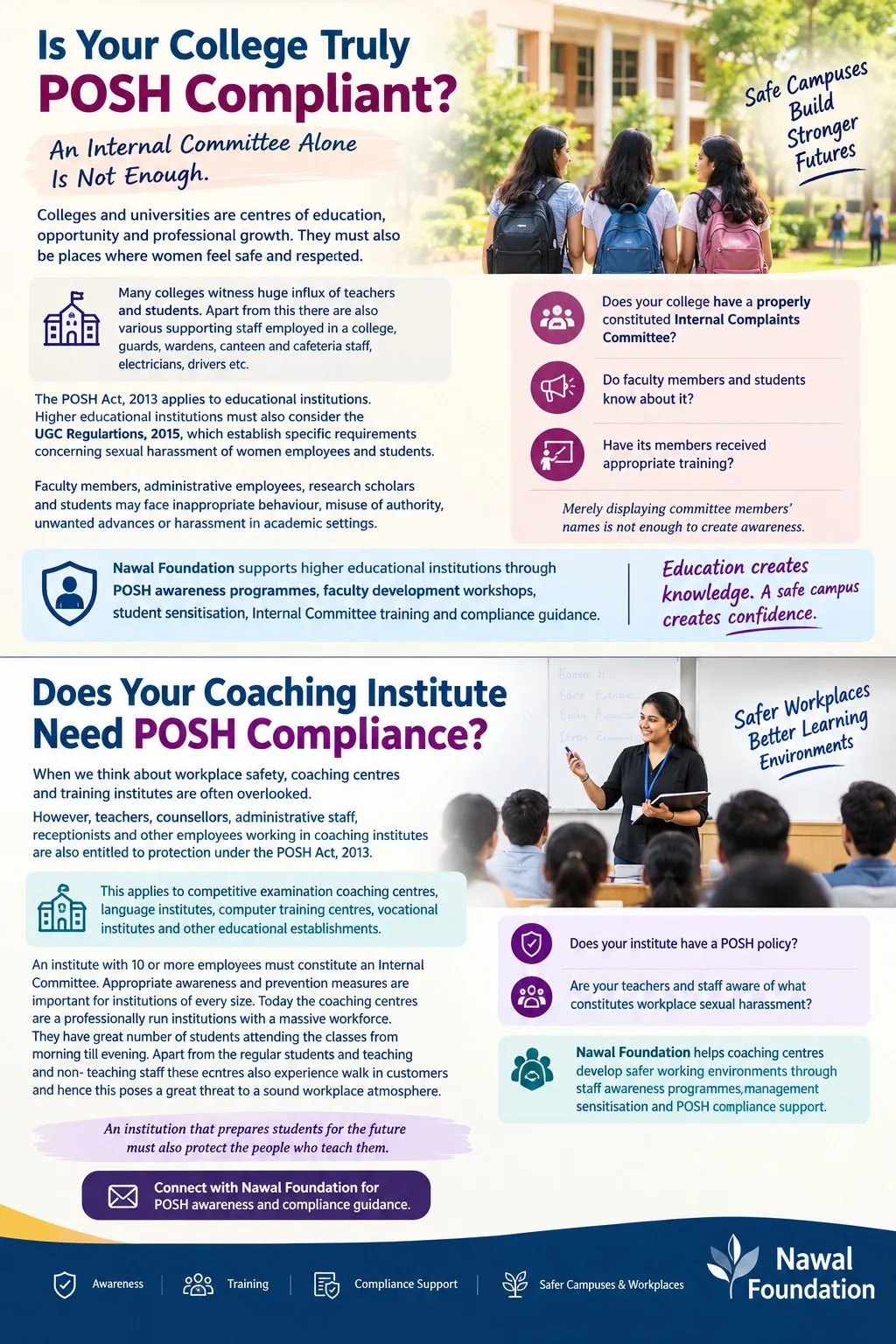
Colleges and universities must be places where women feel safe and respected, whether they are faculty, staff or students. The POSH Act, 2013 applies to educational institutions, and higher education institutions must also follow the UGC Regulations, 2015. But simply forming an Internal Complaints Committee and displaying its members’ names is not enough. Here are the key questions every college must answer to be truly POSH compliant.
Is Your College Truly POSH Compliant? An Internal Committee Alone Is Not Enough.
Colleges and universities are centres of education, opportunity and professional growth. They must also be places where women feel safe and respected. Many colleges witness huge influx of teachers and students. Apart from this there are also various supporting staff employed in a college, guards, wardens, canteen and cafeteria staff, electricians, drivers etc.
The POSH Act, 2013 applies to educational institutions. Higher educational institutions must also consider the UGC Regulations, 2015, which establish specific requirements concerning sexual harassment of women employees and students.
Faculty members, administrative employees, research scholars and students may face inappropriate behaviour, misuse of authority, unwanted advances or harassment in academic settings.
- Does your college have a properly constituted Internal Complaints Committee?
- Do faculty members and students know about it?
- Have its members received appropriate training?
Merely displaying committee members' names is not enough to create awareness.
Nawal Foundation supports higher educational institutions through POSH awareness programmes, faculty development workshops, student sensitisation, Internal Committee training and compliance guidance.
Education creates knowledge. A safe campus creates confidence.
Partner with Nawal Foundation to strengthen campus safety and POSH compliance.